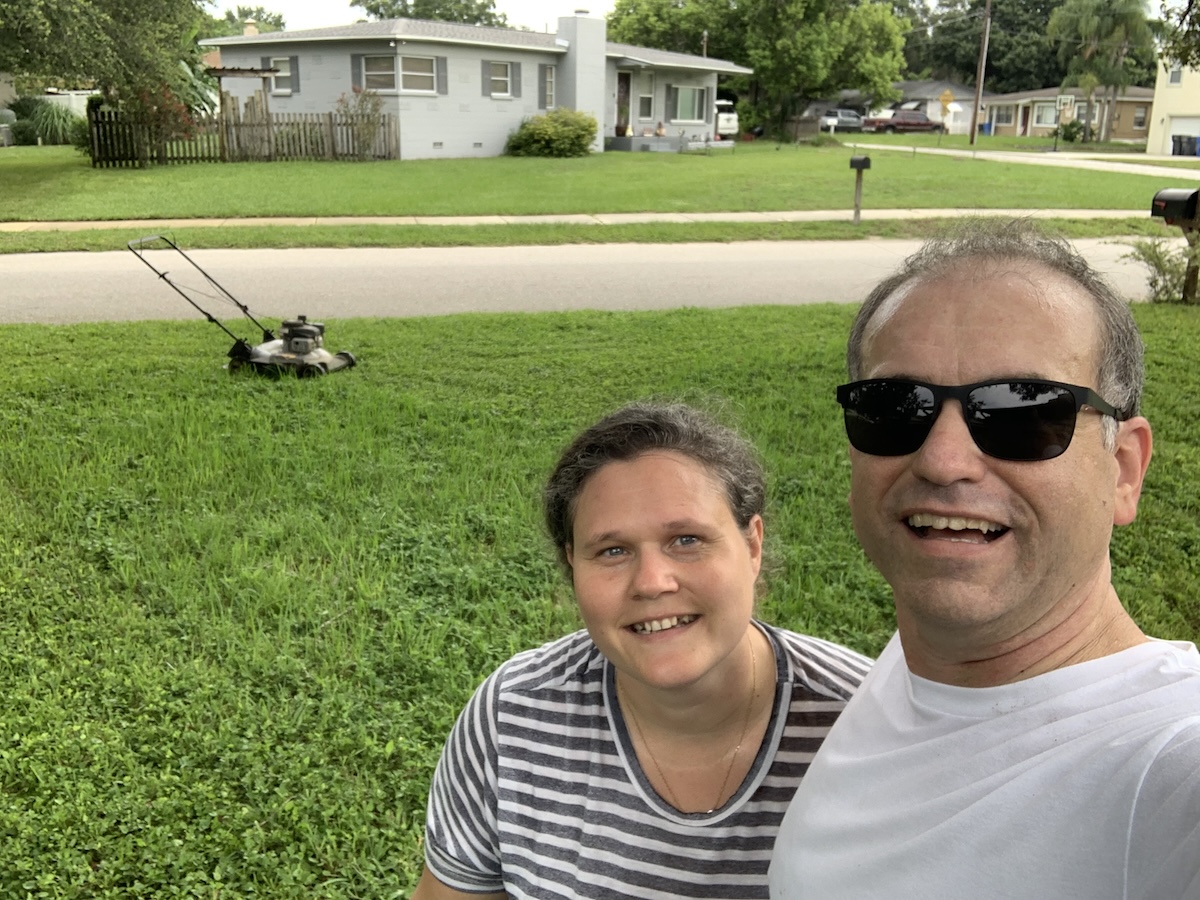
Have you ever heard the phrases “if it’s green, it’s grass”? Or “as long as it’s green, it’s mowed”? Not only have I heard those expressions and use them in my own lexicon, but I also swear by them as a homeowner.
Why? Not only is that landscaping turf grass philosophy lighter on my pocketbook and better on the clock, but it’s also healthier for Mother Nature and can even help ensure a more resilient lawn!
Why If It’s Green It’s Grass Is A Better Approach To Landscaping
For some homeowners, the lawn is the most expensive and time-consuming part of their entire landscape. Not the tress. Nor the flowerbeds. Or even the backyard homestead garden. But the grass. And when you think about it for a minute or two, it’s easy to see why.
For many properties, the lawn consumes the largest area of the yard (maybe besides the footprint of the actual house itself!). But that’s not necessarily why lawns are the most time consuming or most expensive element of the yard. It’s the (sometimes obsessive) perfection that so many homeowners seem to have about their lawns. Many folks are investing endless hours pulling weeds, spending money hand over fist for pest control, taking time for irrigation, applying weed and feed, fertilizing the yard, and handling a variety of other treatments and services to have a picture-perfect green carpet outside.
But what if you didn’t need to do any of those things to have a healthy, green lawn?
All the hours spent plucking anything that isn’t a blade of the grass species you planted, plunking down hundreds of dollars every spring to spread fertilizer, and probably just as much or more on pest control — not to mention whatever it costs to irrigate your yard — are totally unnecessary!
Now, I’m not here to sell you some special lawn elixir, nor will I tell you to tear up your yard and replace it with one big bed of native plants (even though that is generally the best way to go if you want an eco-friendly yard). But what I will tell you to do is lighten your grip on just how “perfect” your lawn has to be and consider embracing a new idea: if it’s green, it’s grass!
Wait? You Mean I Don’t Need A Perfect Lawn?
No! What’s a “perfect” lawn except a vast wasteland?
I mean, growing only one type of grass plant that is usually mowed before it can flower (IF it even visibly flowers at all)? Something that requires expensive and time-consuming weekly maintenance during the growing season? Oh, and because it’s all the same plant the entire yard can just up and die if a disease hits?
Now now, I’ll confess I, too, once strove for the perfect yard…
- I just had to have only St. Augustine grass (Stenotaphrum secundatum) in the front yard.
- I only wanted bahia grass (Paspalum notatum) in the back and side yards.
- Oh, and I spent hours upon hours on my hands and knees pulling out. Virginia pepperweed (Lepidium virginicum), nutsedge (Cyperus derives), Spanish needles (Bidens alba), and other “weeds” common to Central Florida yards like mine!
Thankfully, I never engaged in spraying herbicides (weed killers) and pesticides (bug sprays) across the entire lawn, because I always knew that hurt beneficial creatures like pollinators. And I’ve only ever bought one bag of fertilizer — that was just to help jumpstart some grass plugs I planted.
I also learned that having a polyculture lawn — one consisting of many kinds of plants — was better for the pollinators. And you know what? There’s strength in diversity when it comes to drought, pests, and disease, too.

The Many Benefits Of An If It’s Green It’s Grass Lawn
I learned a lot about the benefits of natural lawns long before being certified as a Florida-Friendly Landscaping Certified Professional. The program teaches many principles of creating a sustainable, environmentally friendly landscape. But it also reinforced the importance of some principles I was already practicing.
Going for an if it’s green it’s grass landscape meant:
Cutting fertilizer costs
I’m not fertilizing. So, I’m not spending money on bags of fertilizer or seasonal fertilizer services from a professional
Reducing irrigation and water bills
Mother Nature provides the irrigation free of charge, and that’s usually all I need to keep the lawn green. After all, the yard is growing with plants that are native or well adapted to my area.
Saving money on sod and grass seed
I don’t need to spend big bucks on growing carpets of grass by purchasing expensive mats of sod or spreading pricey specialized grass seed. Of course, that’s with the exception of fixing holes in the yard or things like tire ruts. I can’t stand ruts and holes! Natural patches of dirt, though? Well, those usually fill in on their own by the middle of the growing season.
Providing more biodiversity to support wildlife
My yard isn’t a monoculture with just one type of grass plant! It’s a miniature jungle filled with dozens of different plants.
Ensuring more flowers and host plants for pollinators
Many of these grassy plants are natives with growth habits that are or mimic ground covers and creepers. They sprout flowers that are low to the ground, missing the mower blades but catching all the butterflies and bees!
Eliminating fertilizer runoff into local waterways and groundwater
No fertilizer means no nitrogen runoff that can propagate or exacerbate harmful algae blooms in lakes, rivers, and streams. Oh, and that means less pollution filtering on down into the might aquifer below!
Spending less time pulling plants that many would classify as weeds
I don’t need to devote one long morning a week during the spring, summer, and fall to pull pesky weeds. Why? Because there’s no such thing as a “weed” in my lawn!
Strengthening the resilience of my yard through plants that can withstand disease and drought
Even if one or two kinds of plants in my lawn are having a tough time with heat, drought, or a certain pest, many other plants do just fine in those tough conditions. So, my lawn stays greener even during trying times.
Having more time and money to enjoy my yard while creating a yard that still looks nice and is friendly to Mother Nature
I’m simply no longer obsessed with having a “perfect” lawn. But I do love having a green lawn — and my imperfect, “weedy” lawn is still good enough for hosting backyard parties, letting young family members play outdoors, or even for staring out over while sipping a nice coffee during pleasant mornings.
Still Keeping A Well-Maintained, Nice Looking Lawn
No, my polyculture, if it’s green it’s grass lawn doesn’t look messy. It doesn’t really even look like it has “weeds,” especially when viewed from the street. I mow it regularly, I edge it, I keep the truly raggedy stuff out. I think my landscape still looks pretty nice, all for a fraction of the time and price — and with a much lower negative impact on Mother Nature.

But What About My HOA? Won’t They Be Upset About All The Weeds In My Yard?
I’ve heard this concern before. But, I don’t live in an HOA — the acronym for a homeowners’ association. As you may know, that’s common shorthand for a community run and managed by a homeowners’ association. There’s nothing inherently wrong with HOAs, at least not in my opinion. Yet, I don’t want a panel of neighbors telling me what I can and can’t grow in my yard.
Unfortunately for those who want to grow an if it’s green it’s grass lawn, some HOAs do have rules that may require you to grow a certain kind of turf grass. In Florida, for example, an HOA can require you to grow St. Augustine, which is a Florida-Friendly Landscaping turf grass, just as the HOA can require Florida homeowners to grow other types of Florida-Friendly Landscaping turf grasses.
However, in Florida, an HOA cannot ban native plants. They can, however, ban invasive or harmful plants. And frankly, you shouldn’t want invasive or harmful plants in your yard anyway.
Now, I’m not a lawyer, nor should my information here or anywhere else on this website constitute legal advice. But I can guide you to Florida Statute 373.185, which spells out a long list of rules and exceptions that Florida HOAs must abide by when it comes to Florida-Friendly Landscaping considerations.
And whether or not you live in Florida, it’s a good idea to approach your HOA with the ideas you have to make your yard a more natural, environmentally friendly landscape. Talk with the board members. Share your reasons for wanting to go natural. Explain the benefits.
Sure, many HOAs may perceive native landscapes as unkempt and messy — and, admittedly, some can look that way. But there’s a way to have a natural landscape and still host a well-maintained if it’s green it’s grass lawn with terrific curb appeal!